In theory & Practice-
There are many reasons why individuals abuse animals. Animal cruelty covers a wide range of actions (or lack of action). Learning about animal abuse has revealed patterns of behavior employed by abusers.
Animal cruelty is often broken down into two main categories: active and passive, also referred to as commission and omission, respectively.
Passive cruelty is typified by cases of neglect, in which the cruelty is a lack of action rather than the action itself. Examples of neglect are starvation, dehydration, parasite infestations, allowing a collar to grow into an animal’s skin, inadequate shelter in extreme weather conditions, and failure to seek veterinary care when necessary.
In many cases of neglect in which an investigator believes that the cruelty occurred out of ignorance, the investigator may attempt to educate the pet owner, then revisit the situation. In more severe cases, exigent circumstances may require that the animal be removed for veterinary care.
Acts of intentional animal cruelty (sometimes referred to as "Non-Accidental Injury") may be indicators of serious psychological problems. According to the American Humane Association, 13% of intentional animal abuse cases involve domestic violence. As many as 71% of pet-owning women seeking shelter at safe houses have reported that their partner had threatened and/or actually hurt or killed one or more of their pets; 32% of these women reported that one or more of their children had also hurt or killed pets. Battered women report that they are prevented from leaving their abusers because they fear what will happen to the animals in their absence. Animal abuse sometimes is used as a form of intimidation in domestic dispute.
Psychological disorders-
One of the known warning signs of certain psychopathologies, including antisocial personality disorder, also known as psychopathic personality disorder, is a history of torturing pets and small animals, a behavior known as zoosadism. According to the New York Times, "[t]he FBI has found that a history of cruelty to animals is one of the traits that regularly appears in its computer records of serial rapists and murderers, and the standard diagnostic and treatment manual for psychiatric and emotional disorders lists cruelty to animals a diagnostic criterion for conduct disorders. "A survey of psychiatric patients who had repeatedly tortured dogs and cats found all of them had high levels of aggression toward people as well, including one patient who had murdered a young boy." Robert K. Ressler, an agent with the Federal Bureau of Investigation's behavioral sciences unit, studied serial killers and noted,"Murderers like this (Jeffrey Dahmer) very often start out by killing and torturing animals as kids."
Cruelty to animals is one of the three components of the Macdonald triad, indicators of violent antisocial behavior in children and adolescents. According to the studies used to form this model, cruelty to animals is a common (but not universal) behavior in children and adolescents who grow up to become serial killers and other violent criminals.
It has also been found that children who are cruel to animals have often witnessed or been victims of abuse themselves. In two separate studies cited by the Humane Society of the United States roughly one-third of families suffering from domestic abuse indicated that at least one child had hurt or killed a pet.
The practice of cruelty to animals for divination purposes is found in ancient cultures, and some modern religions such as Santeriacontinue to do animal sacrifices for healing and other rituals. Taghairm was performed by ancient Scots to summon devils.
TV & film making-
Animal cruelty has long been an issue with the art form of filmmaking, with even some big-budget Hollywood films receiving criticism for allegedly harmful—and sometimes lethal—treatment of animals during production. One of the most infamous examples of animal cruelty in film was Michael Cimino's legendary flop Heaven's Gate, in which numerous animals were brutalized and even killed during production. Cimino allegedly killed chickens and bled horses from the neck to gather samples of their blood to smear on actors forHeaven's Gate, and also allegedly had a horse blown up with dynamite while shooting a battle sequence, the shot of which made it into the film. After the release of the film Reds, the star and director of the picture, Warren Beatty apologized for his Spanish film crew's use of tripwires on horses while filming a battle scene, when Beatty wasn't present. Tripwires were used against horses when Rambo III andThe Thirteenth Warrior were being filmed. An ox was sliced nearly in half during production of Apocalypse Now, while a donkey was bled to death for dramatic effect for the film Manderlay, in a scene later cut from the film.
There is a case of cruelty to animals in the South Korean film The Isle, according to its director Kim Ki-Duk. In the film, a real frog is skinned alive while fish are mutilated. Seven animals were killed for the camera in the controversial Italian film Cannibal Holocaust.The images in the film include the slow and graphic beheading and ripping apart of a turtle, a monkey being beheaded and its brains being consumed by natives and a spider being chopped apart. In fact, Cannibal Holocaust was only one film in a collective of similarly themed movies (cannibal films) that featured unstaged animal cruelty. Their influences were rooted in the films of Mondo filmmakers, which sometimes contained similar content. In several countries, such as the UK, Cannibal Holocaust was only allowed for release with most of the animal cruelty edited out.
More recently, the video sharing site YouTube has been criticized for hosting thousands of videos of real life animal cruelty, especially the feeding of one animal to another for the purposes of entertainment and spectacle. Although some of these videos have been flagged as inappropriate by users, YouTube has generally declined to remove them, unlike videos which include copyright infringement.
The Screen Actors Guild (SAG) has contracted with the American Humane Association (AHA) for monitoring of animal use during filming or while on the set. Compliance with this arrangement is voluntary and only applies to films made in the United States. Films monitored by the American Humane Association may bear one of their end-credit messages. Many productions, including those made in the US, do not advise AHA or SAG of animal use in films, so there is no oversight.
Simulations of animal cruelty exist on television, too. On the September 23, 1999 edition of WWE Smackdown!, a plot line had professional wrestler Big Boss Man trick fellow wrestler Al Snow into appearing to eat his pet chihuahua Pepper.
Circuses-
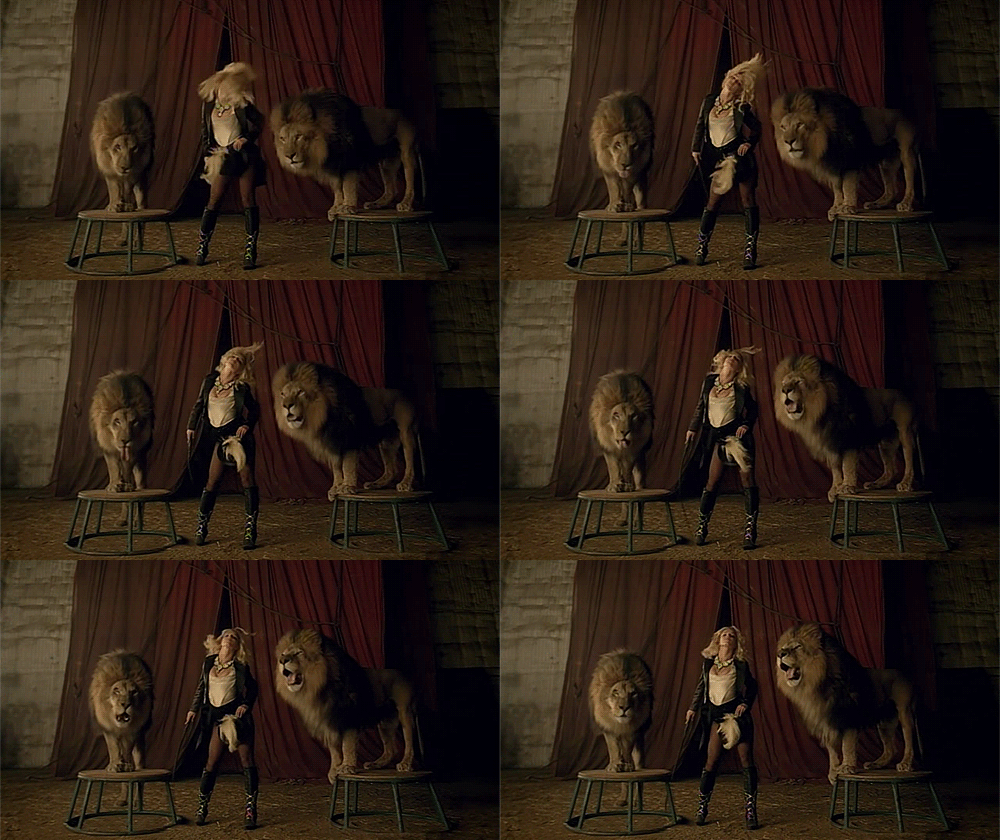
The use of animals in the circus has been controversial since animal welfare groups have documented instances of animal cruelty during the training of performing animals. The Humane Society of the United States has documented multiple cases of abuse and neglect, and cites several reasons for opposing the use of animals in circuses, including confining enclosures, lack of regular veterinary care, abusive training methods and lack of oversight by regulating bodies. Animal trainers have argued that some criticism is not based in fact, including beliefs that animals are 'hurt' by being shouted at, that caging is cruel and common, and the harm caused by the use of whips, chains or training implements.
In 2009, Bolivia passed legislation banning the use of any animals, wild or domestic, in circuses. The law states that circuses "constitute an act of cruelty." Circus operators had one year from the bill's passage on July 1, 2009 to comply.
In 2010, Lebanese animal rights groups became enraged when it was learned that wild performing animals belonging to the Monte Carlo Circus were transported from Egypt to Lebanon without being provided with food and water.
Following the campaign, new regulations were enacted that prohibit the use of animals in circuses in Israel. Finland and Singapore have restricted the use of animals in entertainment. The UK and Scottish Parliaments have committed to ban certain wild animals in travelling circuses and approximately 200 local authorities in the UK have banned all animal acts on council land.[citation needed] Animal acts are still very popular throughout much of Europe, the Americas and Asia. In the United States animal welfare standards are overseen by the United States Department of Agriculture under provisions of the Animal Welfare Act. Efforts to ban circus animals in cities like Denver, Colorado have been rejected by voters. Some circuses now present animal-free acts.
Bullfighting & Crush films-
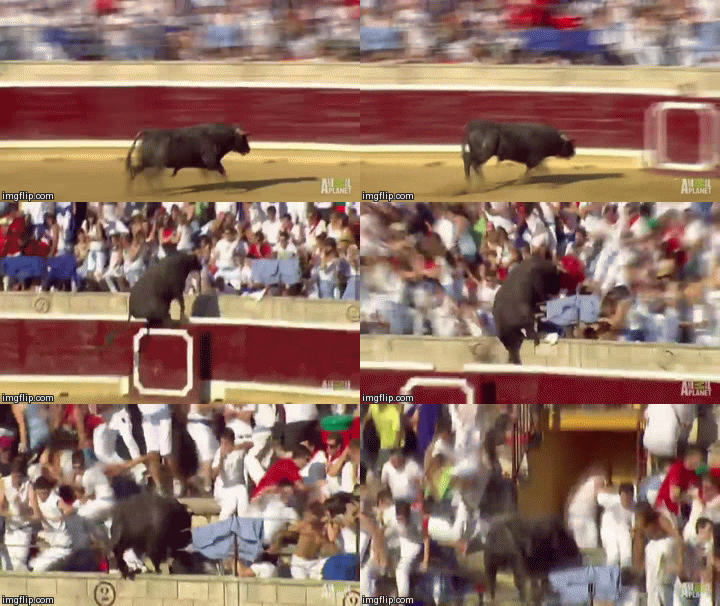
Bullfighting is criticized by animal rights or animal welfare activists, referring to it as a cruel or barbaric blood sport in which the bull suffers severe stress and a slow, torturous death. A number of activist groups undertake anti-bullfighting actions in Spain and other countries. In Spanish, opposition to bullfighting is referred to as antitaurina.
The Bulletpoint Bullfight warns that bullfighting is "not for the squeamish", advising spectators to "be prepared for blood". It details prolonged and profuse bleeding caused by horse-mounted lancers, the charging by the bull of a blindfolded, armored horse who is "sometimes doped up, and unaware of the proximity of the bull", the placing of barbed darts by banderilleros, followed by the matador's fatal sword thrust. It stresses that these procedures are a normal part of bullfighting and that death is rarely instantaneous. It further warns those attending bullfights to "be prepared to witness various failed attempts at killing the animal before it lies down."
The "Toro Jubilo" or Toro embolado in Soria, Medinaceli, Spain, is a festival associated with animal cruelty. During this festival, balls of pitch are attached to a bull's horns and set on fire. The bull is then released into the streets and can do nothing but run around in pain, often smashing into walls in an attempt to douse the fire. These fiery balls can burn for hours, and they burn the bull's horns, body, and eyes – all while spectators cheer and run around the victim. The animal rights group PACMA has described the fiesta as "a clear example of animal mistreatment", and PETA calls it "a sadistic festival".
Animal snuff films, known as crush films can be found on the Internet. These films depict instances of animal cruelty, and/or pornographic acts with animals, usually involving the death of an animal, including insects, mice, rats, guinea pigs, hamsters, monkeys, birds, cats, and dogs. In 1999, the U.S. government banned the depiction of animal cruelty; however, the law was overturned by the 3rd U.S. Circuit Court of Appeals which ruled that the category "depiction of animal cruelty" contained in the law was not an exception to First Amendment protections. In an 8–1 decision handed down in April 2010, the U.S. Supreme Court agreed with the lower court's ruling, but on the grounds that the law was unconstitutionally broad. The case itself did not involve crush films, but rather, a video that in part depicted dogfighting.
Military animals are creatures that have been employed by humankind for use in warfare. They are a specific application of working animals. Examples include horses, dogs anddolphins. Only recently has the involvement of animals in war been questioned, and practices such as using animals for fighting, as living bombs (as in the use of exploding donkeys) or for military testing purposes (such as during the Bikini atomic experiments) may now be criticised for being cruel. Princess Anne, the Princess Royal, the patron of the British Animals in War Memorial, stated that animals adapt to what humans want them to do, but that they will not do things that they don't want to, despite training. Animal participation in human conflict was commemorated in the United Kingdom in 2004 with the erection of the Animals in War Memorial in Hyde Park, London.
In 2008 a video of a US Marine throwing a puppy over a cliff during the Iraq conflict was popularised as an internet phenomenon and attracted widespread criticism of the soldier's actions for being an act of cruelty.
Animal cruelty such as soring, which is legally restricted, sometimes occurs on farms and ranches, as does lawful but cruel treatment such as livestock branding. These practices have been documented by secret photography taken by whistleblowers or undercover operatives from such organizations as Mercy for Animals and the Humane Society of the United States posing as employees.Agricultural organizations such as the American Farm Bureau Federation have successfully advocated for laws that tightly restrict secret photography or concealing information from farm employers.
United States-
The primary federal law relating to animal care and conditions in the US is the Animal Welfare Act of 1966, amended in 1970, 1976, 1985, 1990, 2002 and 2007. It is the only Federal law in the United States that regulates the treatment of animals in research, exhibition, transport, and by dealers. Other laws, policies, and guidelines may include additional species coverage or specifications for animal care and use, but all refer to the Animal Welfare Act as the minimum acceptable standard.
The AWA has been criticized by animal rights groups for excluding birds, rats and mice bred for research, and animals raised for food or fiber as well as all cold-blooded animals.
The Animal Legal Defense Fund releases an annual report ranking the animal protection laws of every state based on their relative strength and general comprehensiveness. In 2010's report, the top five states for their strong anti-cruelty laws were Illinois, Maine, Michigan, Oregon, and California. The five states with the weakest animal cruelty laws were Kentucky, North Dakota, Idaho, Mississippi, and Iowa.
In Massachusetts and New York, agents of humane societies and associations may be appointed as special officers to enforce statutes outlawing animal cruelty.
In 2004, a Florida legislator proposed a ban on "cruelty to bovines," stating: "A person who, for the purpose of practice, entertainment, or sport, intentionally fells, trips, or otherwise causes a cow to fall or lose its balance by means of roping, lassoing, dragging, or otherwise touching the tail of the cow commits a misdemeanor of the first degree." The proposal did not become law.
In the United States, ear cropping, tail docking, rodeo sports, and other acts are legal and sometimes condoned. Penalties for cruelty can be minimal, if pursued. Currently, 46 of the 50 states have enacted felony penalties for certain forms of animal abuse. However, in most jurisdictions, animal cruelty is most commonly charged as a misdemeanor offense. In one recent California case, a felony conviction for animal cruelty could theoretically net a 25 year to life sentence due to their three-strikes law, which increases sentences based on prior felony convictions.
In 2003, West Hollywood, California passed an ordinance banning declawing of house cats. In 2007, Norfolk, Virginia passed legislation only allowing the procedure for medical reasons. However, most jurisdictions allow the procedure.
In April 2013, Texas Federal Court Judge Sim Lake ruled that videos showing cruelty to animals are protected by the First Amendment to the United States Constitution despite laws against cruelty to animals and evidence that cruelty to animals can be a precursor to cruelty to human beings as well as murder. A petition has been launched to reverse this ruling.
India-
The Prevention of Cruelty to Animals Act,1960 was amended in the year 1982. According to the newly amended Indian animal welfare act,2011 cruelty to animals is an offence and is punishable with a fine which shall not be less than ten thousand Rupees,which may extend to twenty five thousand Rupees or with imprisonment up to two years or both in the case of a first offence.In the case of second or subsequent offence,with a fine which shall not be less than fifty thousand Rupees, but may extend to one lakh Rupees and with imprisonment with a term which shall not be less than one year but may extend to three years.